

Our Solutions
Our solutions begin with a fundamental improvement to the mathematical frameworks used to model motion, energy transport, and diffusion in engineering systems. Traditional simulation tools rely on transport models derived from Fourier heat diffusion and Navier–Stokes formulations, which treat complex transport phenomena largely through statistical averaging.
Our PRISM engine introduces a deterministic operator framework that more accurately captures how energy, heat, and motion propagate through structured geometries. By resolving the physical pathways that govern transport rather than smoothing them away, our platform reveals bottlenecks, instability zones, and emerging hotspots that conventional simulations often miss.
The result is a new generation of deterministic digital twins capable of predicting system behavior across complex infrastructure—from data centers and aerospace systems to advanced manufacturing—allowing engineers to diagnose, simulate, and optimize systems with far greater clarity.
Deterministic digital twin models that reproduce the governing transport dynamics of real engineering systems. These models simulate how energy, heat, and motion evolve across complex geometries, providing a physics-consistent representation of system behavior.


Analytical diagnostics that extract the structure of transport within a system once a digital twin or dataset is available. PRISM Transport Intelligence identifies constrained pathways, curvature-driven amplification, and emerging hotspot regions where classical diffusion models lose predictive accuracy.




Design and operational optimization using the transport structure revealed by PRISM Optimization. Engineers can modify geometry, cooling architecture, or operating conditions to eliminate instability zones and improve efficiency before physical deployment.
Academic Research
Our research revisits the mathematical foundations of motion and diffusion that have guided physics and engineering for more than two centuries. Classical frameworks—from Fourier heat transport to Navier–Stokes dynamics—treat complex transport behavior largely through statistical averaging, interpreting irregular behavior as randomness. Our work demonstrates that in many engineered systems this apparent randomness arises instead from unresolved geometric structure in the underlying energy field. By embedding our entropy–geometry framework directly into the governing transport operator, we derive a deterministic framework that extends classical diffusion while recovering it exactly as a limiting case in smooth regimes.
This framework has been empirically validated across more than 100 experimental and industrial datasets spanning multiple physical domains. These include semiconductor thermal maps, structured reactor systems, turbine blade heat-transfer experiments, and large-scale infrastructure environments such as air-cooled data centers. Across these systems, the results consistently show that persistent hotspots, instability zones, and transport bottlenecks emerge deterministically from geometry and load rather than from stochastic fluctuations.
The cross-domain consistency of these results is critical. The same structured transport principles that explain hotspot persistence in silicon microchips also explain thermal localization in packed beds, curvature-driven amplification in turbine blades, and rack-level hotspot formation in data centers. This body of work establishes a unified geometric interpretation of transport processes, providing the scientific foundation for PRISM’s deterministic digital twin technology.
Whitepapers








Across these whitepapers, a consistent and fundamental result emerges: transport in real-world systems is not inherently diffusive, it is geometry-constrained and therefore deterministic. Whether analyzing data centers, semiconductor chips, gas turbines, packed-bed reactors, or even quantum systems, we observe the same pattern. Classical models based on Fourier and Navier–Stokes assumptions perform well in smooth regimes, but they systematically fail in structured environments where motion is constrained. In these regimes, hotspots, amplification zones, and localized failures are not random, they are direct consequences of geometry and system configuration.
The PRISM framework introduces a shift from mesh-driven simulation to operator-driven modeling, where transport is governed by geometry-aware operators rather than uniform diffusion assumptions. Instead of approximating behavior through dense discretization, PRISM encodes the physical constraints that determine how motion evolves. This allows it to capture phenomena that classical methods smooth away, such as: persistent hotspots, curvature-driven amplification, and confined transport, while still reducing exactly to classical physics when diffusion is valid.
Across domains, the results are strikingly consistent. In data centers, worst-case thermal behavior is deterministically predicted from layout and load. In semiconductor systems, the model achieves substantial improvements in hotspot boundary accuracy, precisely where performance and reliability are governed. In turbine blades, it identifies curvature-driven turbulence amplification that persists under confinement. Even in quantum systems, behavior traditionally treated as stochastic is shown to organize along structured operator modes when geometry becomes active.
For engineers and industry, this translates into a step-change in capability. Prediction becomes both more accurate and dramatically more efficient, reducing reliance on massive meshes, iterative tuning, and empirical correction factors. Instead of simulating everything, engineers can directly identify where motion is constrained, where energy accumulates, and where failure will occur. This enables faster design cycles, reduced overengineering, and more reliable systems across applications.
Ultimately, these whitepapers demonstrate that determinism is not absent in complex systems, it has simply been obscured by incomplete models. When geometry is properly accounted for, apparent randomness resolves into structured, predictable behavior. The transition from mesh-based to operator-based simulation is therefore not just a computational improvement, but a paradigm shift in how motion and transport are understood, unlocking a new generation of deterministic, physics-aligned digital twins for engineering and industry.





This paper challenges a core assumption in classical modeling: that heat and energy move uniformly through space via diffusion. While Fourier and Navier–Stokes frameworks work well in smooth systems, they break down in structured environments where geometry constrains motion. In these cases, what appears as randomness or noise is actually the result of unresolved structure—hidden pathways and constraints that classical models average out. By reintroducing geometry as a primary variable, the paper shows that transport is not inherently diffusive, but structured and multi-modal. Energy does not spread evenly—it follows admissible pathways, accumulates where motion is constrained, and redistributes when those constraints shift. This explains key behaviors such as hotspots, delayed release, and long-tailed decay that diffusion models cannot capture.To address this, the paper introduces an operator-based framework that encodes geometry directly into the governing model. Instead of relying on dense meshes and empirical tuning, it resolves how motion actually unfolds within the system. The result is more accurate prediction, clearer physical insight, and a shift toward deterministic, geometry-driven simulation for engineering and industry.
This paper addresses one of the most fundamental questions in fluid dynamics: whether solutions to the Navier–Stokes equations can develop singularities, or “blow up,” in finite time. Rather than approaching the problem through classical bounds or numerical approximation, it reframes the question in terms of energy structure and geometric evolution. The analysis shows that blow-up is not simply a question of magnitude, but of whether curvature and energy can accumulate without constraint. By introducing a Lyapunov–Perelman style accounting framework, the paper demonstrates that such uncontrolled accumulation is structurally forbidden. Energy amplification is continuously balanced by dissipation and geometric constraints, preventing the system from reaching singular states. What appears as chaotic or unstable behavior is instead governed by a deeper conservation and redistribution mechanism that preserves regularity. This leads to a new interpretation of fluid motion: turbulence and complexity are not pathways to singularity, but manifestations of structured energy evolution. Rather than allowing arbitrary blow-up, the system remains bounded through an intrinsic balancing process. The result is a deterministic framework for understanding fluid behavior, providing both a resolution to the regularity problem and a new lens for interpreting motion in complex systems.
This paper addresses one of the oldest problems in number theory: whether every even integer greater than two can be expressed as the sum of two primes. Rather than approaching the conjecture through probabilistic methods or asymptotic bounds, the work reframes the problem in terms of structure, showing that prime pairings emerge from an underlying geometric and operator-based framework rather than randomness. By introducing a deterministic operator perspective, the paper demonstrates that the distribution of primes is not arbitrary, but governed by structured constraints that dictate how valid pairings form. What has traditionally been interpreted as irregular or unpredictable behavior is instead shown to follow consistent patterns when viewed through the correct mathematical lens, revealing an inherent organization within the prime number system. This leads to a reinterpretation of the Goldbach Conjecture as a structural identity rather than a statistical phenomenon. Instead of relying on probability or density arguments, the proof framework shows that valid decompositions arise naturally from the geometry of the number line itself. The result is a deterministic understanding of prime behavior, offering both a resolution to the conjecture and a broader insight into the nature of mathematical structure and identity.
Deterministic Modeling of Motion for Engineering Systems
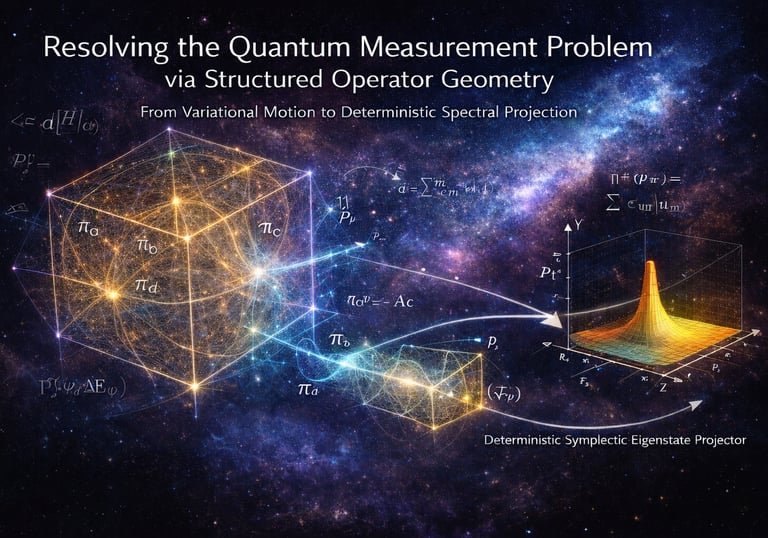
This paper addresses one of the most fundamental problems in physics: the apparent incompatibility between deterministic evolution and probabilistic measurement in quantum mechanics. Rather than accepting this duality as intrinsic, the work reframes the problem in terms of operator completeness, showing that measurement emerges from an underlying geometric and operator-based structure rather than randomness. By introducing a structured admissibility field and completing the governing operator, the paper demonstrates that quantum evolution and measurement are not separate processes, but expressions of a single deterministic framework. What has traditionally been interpreted as stochastic collapse is instead shown to arise from constraint-induced projection within a geometry-defined spectral manifold. This leads to a reinterpretation of the measurement problem as a failure of operator closure rather than a fundamental limit of physical law. Instead of relying on probabilistic postulates such as the Born rule, the framework shows that observed outcomes follow directly from admissible structure and domain restriction. The result is a deterministic understanding of quantum behavior, providing a resolution to the measurement problem and a broader unification of motion across classical, quantum, and relativistic regimes.
Industry Validation & Real-World Applications
AstraNomos turns foundational research into practical simulation capability. Our operator-based framework is not limited to theory or academic publication; it is used to model, simulate, and interpret complex systems across both industry and science. We move from first-principles research to real-world digital twin workflows, predictive simulation studies, and custom technical analyses designed for high-stakes physical environments.
Our work is validated across a broad range of domains where conventional diffusion-only or statistical models are often insufficient. These include energy systems, aerospace and turbomachinery, nuclear and reactor environments, quantum systems, advanced manufacturing, biomedical modeling, and large-scale scientific data analysis. In our published research, this includes applications spanning galaxy rotation curves, gravitational-wave signals, quantum coherence experiments, fusion-plasma turbulence, particle data, biological coherence models, and structured transport simulations.
For customers and research partners, we provide simulation-driven services that translate this framework into actionable insight. This includes case studies, custom simulations, digital twin modeling, hotspot and transport analysis, predictive maintenance workflows, operator-based diagnostics, and technical research support for systems where geometry, confinement, and structured motion matter. Our work is designed to help organizations understand where traditional models fail, where structure becomes active, and how deeper physics-based modeling can reveal what coarse methods miss.
In this sense, AstraNomos operates at the boundary between research and deployment. We publish the mathematical and scientific foundation, and we also apply it through simulation services across domains in industry and science. The result is a platform that does not stop at whitepapers: it advances from validated theory into engineering analysis, scientific modeling, and real-world problem solving across complex physical systems.