
Simulation Where It Matters Most
The AstraNomos PRISM simulation engine applies to systems governed by transport physics: heat, fluid motion, energy propagation, and constrained flow. Across industries, these systems are traditionally modeled using large mesh-based simulations that require millions or billions of computational cells. By identifying the underlying transport modes of a system, PRISM dramatically reduces simulation complexity while revealing the physical pathways that govern system behavior.
In conventional simulation workflows, engineers reconstruct physical behavior indirectly through dense spatial discretization. The governing equations are approximated locally across an enormous mesh, and the solver must iteratively update each cell until the global field converges. While this approach has enabled decades of progress in computational fluid dynamics and thermal modeling, it often requires enormous computational resources and extended runtime simply to recover structures that are already implicit in the physics of the system.
The PRISM framework approaches this problem from a fundamentally different perspective. Instead of attempting to resolve every point in the spatial domain, the system is analyzed through the spectral structure of its governing transport operator. The resulting eigenmodes represent the natural pathways through which energy, momentum, or heat propagate through the geometry. In many real engineering environments, the dominant dynamics of the system are governed by a relatively small set of such modes.
This spectral representation significantly reduces the effective dimensionality of the simulation. Where classical mesh-based approaches must evolve millions or billions of spatial variables, operator-based modeling evolves only the amplitudes associated with the physically admissible transport modes. The result is a simulation that captures the essential structure of the system with far fewer degrees of freedom, while maintaining direct interpretability of the underlying physical processes.
Equally important, the operator framework reveals transport behavior that traditional diffusion-based models often smooth away. Localized amplification zones, thermal hotspots, channelized flow paths, and confined transport regions emerge naturally within the spectral structure of the governing operator. Rather than treating these phenomena as stochastic irregularities, the PRISM engine identifies them as deterministic manifestations of the geometry and boundary conditions governing the system.
For industries that depend on large-scale simulation—such as semiconductor design, aerospace engineering, energy infrastructure, advanced manufacturing, and high-performance computing—this shift represents more than a computational optimization. It enables engineers to model complex systems faster, diagnose critical transport structures earlier, and make design decisions with a clearer understanding of the physical mechanisms driving system behavior. In this way, operator-based simulation transforms digital twins from brute-force numerical models into physics-driven representations of the true structure of motion.
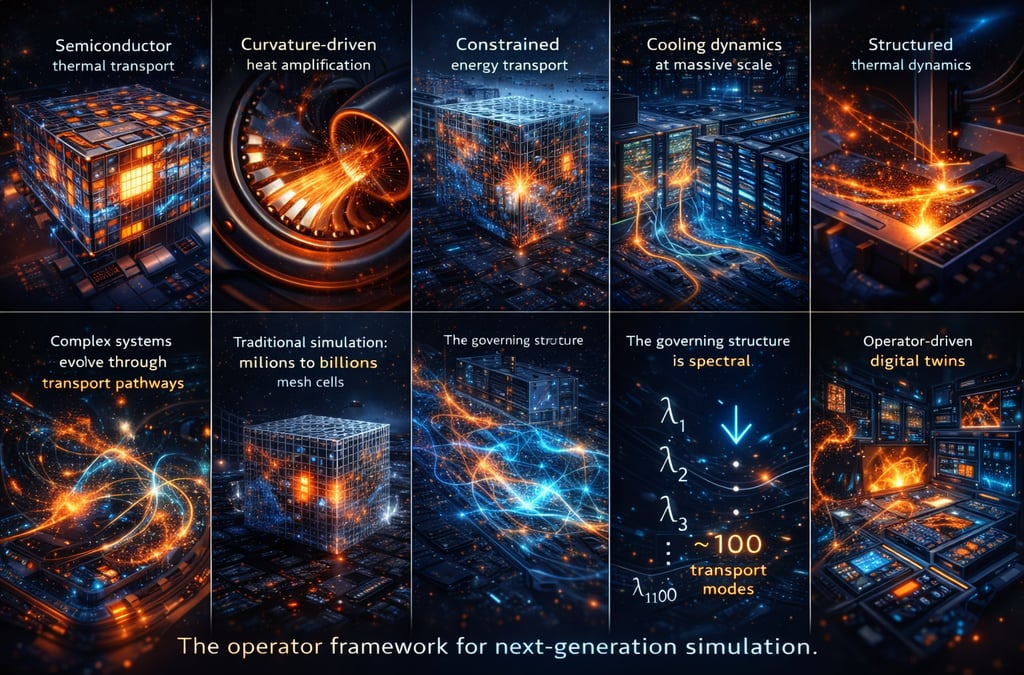
The above image presents a unified narrative about how complex industrial systems are currently simulated and how that paradigm changes under the operator framework developed in the AstraNomos research program. The upper panels show a variety of engineering domains—semiconductor thermal transport, turbine heat amplification, constrained energy transport in reactors, data-center cooling, and advanced manufacturing. Although these systems appear unrelated at the application level, they are all governed by the same class of physical processes: transport under geometric constraint. Heat diffusion, fluid momentum, and energy propagation evolve through physical pathways defined by the geometry and boundary conditions of the system. The visual message of the first row is therefore that modern industry is built upon systems whose dynamics are ultimately governed by transport physics.
The second row explains how those systems are typically simulated today. In most engineering workflows, the governing equations—often derived from Fourier heat diffusion or the Navier–Stokes equations—are approximated through spatial discretization. Engineers construct meshes containing millions or billions of computational cells and solve the governing partial differential equations iteratively across that grid. This approach has been enormously successful, but it reconstructs system behavior indirectly. The solver must numerically recover the underlying structure of the system through repeated updates of every cell. The result is a computationally intensive process in which the governing physics is approximated through large numerical reconstructions rather than directly represented.
The AstraNomos operator framework addresses this limitation by focusing on the spectral structure of the governing transport operator. Rather than resolving every spatial degree of freedom through a dense mesh, the framework analyzes the eigenmodes of the operator governing the system. These eigenmodes represent the natural transport pathways through which energy, momentum, or heat propagate. In practical industrial environments, the dominant behavior of a system is often governed by a relatively small number of such modes. When the system is expressed in this spectral basis, the effective dimensionality collapses from billions of mesh variables to a small set of transport modes that encode the admissible dynamics of the geometry.
This perspective connects directly to the historical development of operator theory in mathematics and physics. During the twentieth century, mathematicians such as Hermann Weyl, John von Neumann, and Edward Titchmarsh developed the spectral theory of self-adjoint operators, establishing that the dynamics of many physical systems can be understood through their eigenvalue structure. Earlier work by Herglotz and Carleman established conditions under which spectral measures uniquely determine the underlying operator, while the Sturm–Liouville framework provided a canonical form for differential operators governing physical processes. In quantum mechanics, this operator viewpoint became fundamental: physical states evolve according to the spectral structure of the Hamiltonian operator rather than through explicit trajectory reconstruction.
The operator-based simulation approach extends this same principle to engineering transport systems. Instead of treating complex flows or thermal fields as fundamentally stochastic phenomena requiring dense discretization, the framework interprets them as projections onto the eigenmodes of the governing transport operator. Apparent randomness often arises when the geometric structure governing the system is unresolved. Once the appropriate operator is identified, the dynamics organize along a restricted set of admissible modes. In this sense, randomness is not an intrinsic property of the system but a consequence of incomplete representation of its governing structure.
By identifying these operator modes directly, the PRISM simulation engine restores a deterministic representation of system dynamics. Simulations evolve along the physically admissible transport modes of the geometry rather than reconstructing behavior through brute-force mesh refinement. This dramatically reduces the number of degrees of freedom required to represent the system while preserving the essential physics governing its evolution. The result is a simulation framework that is both computationally efficient and physically interpretable, enabling engineers to model complex systems through the same operator structures that have long governed modern mathematical physics.
Seen in this context, the image represents more than a visualization of industrial applications. It illustrates a conceptual shift in how motion is represented computationally. Classical mesh-based simulation approximates the field everywhere and attempts to recover the governing dynamics through numerical iteration. Operator-based simulation instead begins with the governing structure of motion itself. By identifying the spectral modes that define the system, it allows digital twins to evolve directly along those modes, revealing the true structure of motion across industrial systems while eliminating the need for massive mesh reconstruction.
Revealing the Structure of Motion in Industry


Industries We Serve
The AstraNomos PRISM framework applies to systems governed by heat, fluid, motion, and constrained energy transport across modern industry
This image illustrates the core challenge facing the semiconductor and AI hardware industry: extreme thermal transport under rapidly increasing power density. Modern CPUs, GPUs, AI accelerators, and advanced packaging architectures—particularly 3D stacked dies—generate localized heat flux that can exceed several hundred watts per square centimeter. Under these conditions, thermal behavior is governed not only by material conductivity but by geometry-driven transport constraints that produce persistent hotspots and steep gradient interfaces. Conventional simulation approaches attempt to capture this behavior using dense mesh-based discretization of the heat equation or coupled electro-thermal models, often requiring millions to billions of mesh cells to approximate the field accurately. The AstraNomos PRISM simulation engine approaches the problem differently by identifying the spectral structure of the governing transport operator. Instead of reconstructing thermal behavior across massive spatial meshes, PRISM isolates the dominant transport modes that govern heat propagation through the chip architecture. In practice, this reduces the effective dimensionality of the problem dramatically while revealing the actual pathways through which heat flows and accumulates within the silicon stack.
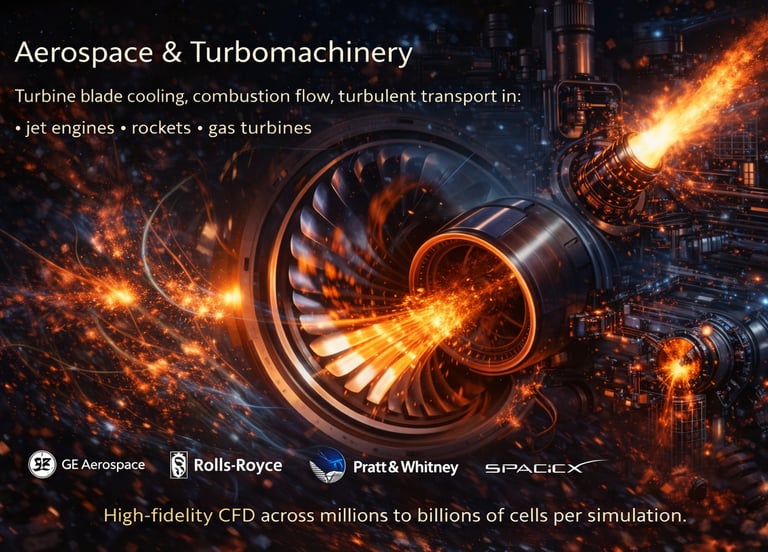
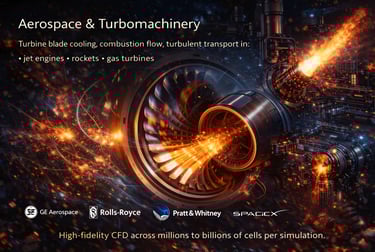
This image illustrates the core challenge facing the aerospace and turbomachinery industry: extreme heat transfer and turbulent flow within geometrically constrained environments such as turbine blades, combustion chambers, rocket engines, and high-pressure gas turbines. Modern propulsion systems operate under conditions where temperatures can exceed thousands of degrees and fluid velocities generate highly complex boundary-layer dynamics, vortex structures, and steep thermal gradients. Under these conditions, heat and momentum transport are governed not only by material properties but by the geometry of cooling channels, blade curvature, and constrained flow pathways that shape how energy moves through the system. Conventional simulation approaches attempt to capture these dynamics through dense mesh-based discretization of the Navier–Stokes and heat transport equations, often requiring millions to billions of computational cells and massive high-performance computing resources to approximate the evolving field. The AstraNomos PRISM simulation engine approaches this problem differently by identifying the spectral structure of the governing transport operator. Rather than reconstructing turbulent transport across enormous meshes, PRISM isolates the dominant transport modes that govern the propagation of energy and momentum through the engine geometry. In practice, this dramatically reduces the effective dimensionality of the simulation while revealing the underlying pathways through which heat, pressure, and turbulence evolve across turbomachinery systems.
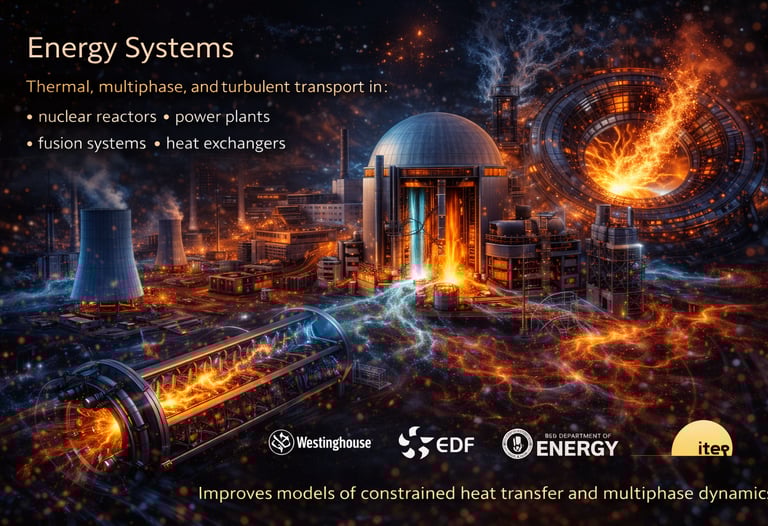
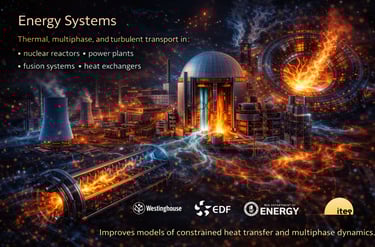
This image captures the fundamental challenge in modern energy systems: accurately modeling the coupled transport of heat, fluid, and phase behavior within highly constrained and heterogeneous environments. In nuclear reactors, fusion devices, and large-scale power systems, energy transport occurs across complex geometries where flow channels, material interfaces, and thermal gradients interact to produce localized instabilities, recirculation zones, and nonlinear propagation effects. These systems are inherently multiscale, with global behavior driven by localized transport structures that are difficult to resolve using conventional modeling approaches. Traditional simulation frameworks rely on high-resolution discretization of the governing equations, requiring extensive mesh refinement to capture boundary layers, phase transitions, and turbulent interactions. As system complexity increases, the number of computational elements grows rapidly, leading to high computational cost and limited interpretability of the results. The AstraNomos PRISM framework addresses this by representing the system through the spectral structure of its governing operator, allowing the dominant transport mechanisms to emerge directly from the geometry. By evolving only the physically admissible modes of energy transport, the framework reduces computational burden while providing a clearer representation of how heat, pressure, and multiphase dynamics propagate through energy infrastructure.
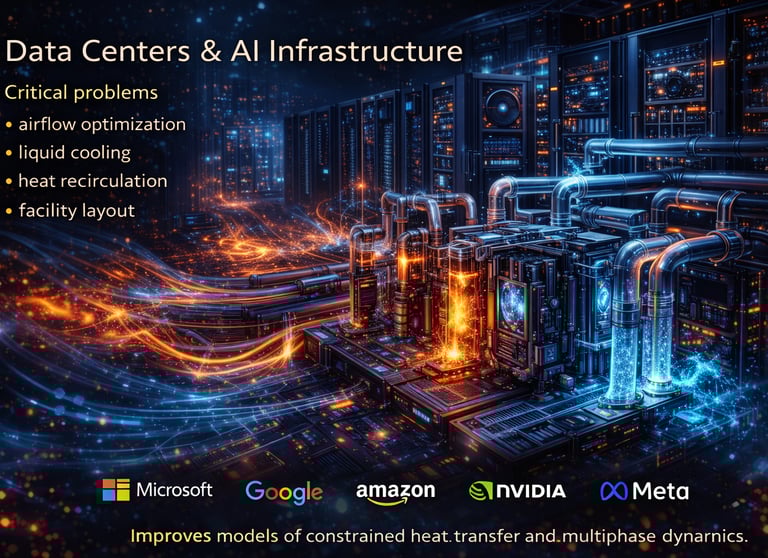
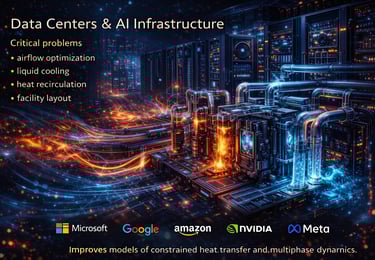
This image illustrates the core challenge facing modern data centers and AI infrastructure: the efficient management of heat and airflow within densely packed, high-power computing environments. As computational demand increases, racks of servers and accelerators generate significant localized heat loads, often exceeding the capacity of traditional cooling strategies. Airflow patterns become highly complex, with recirculation zones, thermal stratification, and localized hotspots forming due to facility layout constraints and equipment density. Conventional simulation approaches attempt to model these environments through large-scale computational fluid dynamics frameworks, requiring extensive mesh discretization to capture airflow, temperature gradients, and cooling interactions across the facility. This results in high computational cost and often limited clarity into the underlying transport mechanisms driving inefficiencies. The AstraNomos PRISM simulation engine addresses this by identifying the dominant transport modes governing airflow and heat propagation within the data center geometry. By representing the system through its spectral structure rather than dense spatial meshes, PRISM reveals the pathways responsible for heat accumulation and recirculation while significantly reducing the dimensionality of the simulation. This enables more efficient modeling of cooling strategies, improved facility layout optimization, and more accurate prediction of thermal behavior, allowing operators to reduce energy consumption, prevent hotspots, and maximize performance across large-scale AI infrastructure.
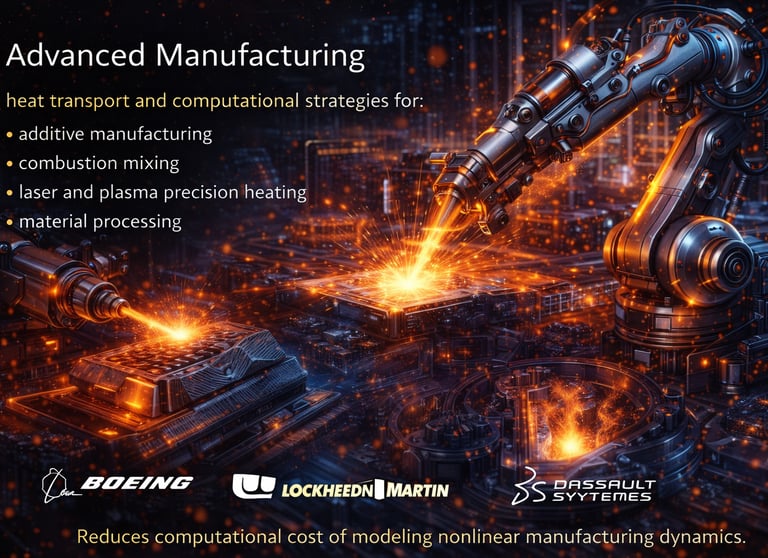
This image illustrates the core challenge facing advanced manufacturing systems: accurately modeling heat transport and material behavior within highly localized, rapidly evolving process environments. In additive manufacturing, laser processing, and precision material fabrication, energy is introduced into the system at extremely high intensities, producing steep thermal gradients, rapid phase transitions, and complex melt pool dynamics. These processes are governed not only by material properties but by the interaction between energy input, geometry, and transient transport pathways that determine how heat propagates, concentrates, and dissipates during fabrication. Conventional simulation approaches attempt to capture these effects through fine mesh-based discretization of heat and fluid transport equations, often requiring significant computational resources to resolve the evolving geometry and multiphysics interactions. However, these methods can struggle to accurately represent localized transport behavior and frequently rely on empirical adjustments to match observed results. The AstraNomos PRISM simulation engine addresses this by identifying the spectral structure of the governing transport operator, allowing the dominant energy pathways within the manufacturing process to be represented directly. By isolating the transport modes that control melt pool evolution, heat diffusion, and phase change, PRISM reduces the effective dimensionality of the simulation while providing clearer insight into process dynamics. This enables more accurate prediction of material behavior, improved process control, and faster optimization of manufacturing parameters, ultimately leading to higher quality components and more efficient production workflows.
Across each of the industries presented—semiconductors, aerospace, energy systems, data centers, and advanced manufacturing—the AstraNomos PRISM framework has been applied to the same underlying problem: accurately modeling transport dynamics under geometric constraint. In every case, conventional simulation pipelines rely on dense mesh-based discretization to approximate governing equations derived from Fourier diffusion or Navier–Stokes flow. Our work does not replace these equations; rather, it reveals their deeper structure. The operator formulation reduces exactly to classical diffusion in regimes where curvature and confinement are negligible, ensuring full compatibility with established physics. However, in regions where geometry dominates—such as hotspot boundaries, turbulent interfaces, or constrained flow pathways—the operator framework departs from purely diffusive behavior and captures the localized transport structures that traditional models tend to smooth away.
This dual behavior is central to the performance gains observed across datasets. By identifying the spectral structure of the governing transport operator, PRISM isolates the dominant transport modes that define system behavior. Instead of resolving millions or billions of mesh variables, the simulation evolves a reduced set of physically admissible modes, dramatically lowering the effective dimensionality of the problem. At the same time, because these modes correspond directly to real transport pathways, the resulting simulations are not only computationally efficient but also more physically interpretable. This allows engineers to identify where classical diffusion is sufficient and where structured transport—driven by geometry, curvature, or confinement—governs the system.
In practical deployments, this has translated into measurable improvements in predictive accuracy precisely in the regions that matter most: thermal hotspots in semiconductor devices, heat amplification zones in turbine blades, recirculation regions in data centers, and localized phase transitions in manufacturing processes. These are the regions where traditional models require extensive mesh refinement or empirical correction, yet still struggle to capture the underlying dynamics. By contrast, the operator framework identifies these structures directly as manifestations of the system’s spectral organization, enabling earlier detection, clearer diagnostics, and more efficient simulation workflows.
This shift also reframes the concept of a digital twin. In current industry practice, digital twins are often high-resolution numerical replicas of physical systems, dependent on large-scale computation to approximate behavior. In the operator framework, a digital twin becomes a representation of the system’s governing transport structure. Rather than simulating every point in space, it evolves along the modes that define how energy and motion propagate. This aligns more closely with the original intent of a digital twin: not just to replicate a system, but to understand and predict its behavior in real time.
From a historical perspective, this approach returns simulation to the trajectory established by the development of modern mathematical physics. From Galileo’s study of motion to Newton’s formulation of dynamical laws, and later to the operator-based frameworks of Weyl, von Neumann, and Sturm–Liouville theory, the goal has always been to identify the governing structure underlying physical phenomena. Mesh-based simulation represents a powerful numerical tool, but it reconstructs this structure indirectly through computation. The AstraNomos PRISM framework completes this progression by resolving motion at the level of its governing operator, allowing complex systems to be simulated through the spectral modes that define them. In doing so, it restores a deterministic, structured understanding of motion while significantly reducing the computational burden required to model it.
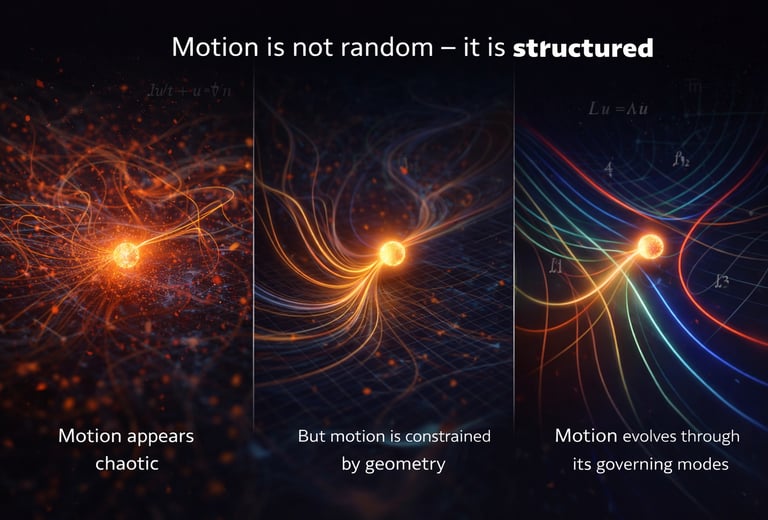
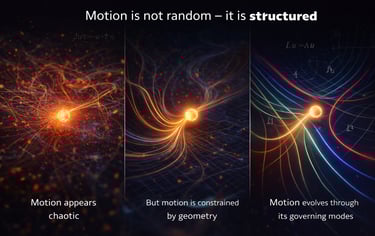
This image presents a conceptual progression in our understanding of motion, tracing a path from classical physics to modern operator-based frameworks. On the left, motion appears chaotic—this reflects the early challenges faced even after the breakthroughs of Isaac Newton, whose laws described motion deterministically but became intractable in complex systems. As physics advanced, Joseph Fourier introduced diffusion as a way to model aggregate behavior, smoothing motion into continuous fields. Later, Claude-Louis Navier and George Gabriel Stokes formalized fluid motion through the Navier–Stokes equations, capturing turbulence and transport but at the cost of requiring immense computational reconstruction. Even Albert Einstein, in extending motion to spacetime and statistical systems, acknowledged that complex motion often appears probabilistic when underlying structure is not directly accessible.
The central panel reflects this turning point: what appears random is not inherently stochastic, but rather unresolved structure. Classical simulation treats randomness as intrinsic because it approximates motion through discretization—breaking space into millions or billions of cells and numerically evolving them. In this process, the governing structure of motion is not explicitly represented; it is recovered indirectly through computation. This is where the modern mathematical framework of operator theory—developed by figures such as John von Neumann, Hermann Weyl, and Edward Titchmarsh—becomes essential. Their work showed that physical systems can be understood through the spectral properties of operators, where motion is governed by eigenmodes rather than arbitrary trajectories. Supporting results from Gustav Herglotz and Torsten Carleman established that under the right conditions, these spectral representations are not approximations—they are complete and deterministic.
The right side of the image visualizes this insight: motion collapses into structured pathways—eigenmodes of the governing operator. In the AstraNomos framework, this corresponds to a modified Sturm–Liouville operator that encodes geometry, curvature, and transport constraints directly into the system. Instead of treating motion as a field evolving over billions of mesh points, the system is represented through a small set of admissible transport modes. Classical diffusion emerges naturally as a limiting case when curvature vanishes, but in regions where structure matters—hotspots, turbulence, confinement—the operator reveals deterministic pathways that traditional models blur into noise.
This reframing of randomness is the key breakthrough. What has historically been treated as stochastic behavior is, in this framework, the inactive limit of structured motion. When the governing operator is not explicitly resolved, motion appears chaotic; when it is, the system organizes along its spectral modes. This allows simulation to move from brute-force reconstruction to direct representation. In practical terms, this reduces simulation dimensionality by orders of magnitude—from millions or billions of grid cells to on the order of ~100 transport modes—while preserving and even enhancing predictive accuracy where classical methods struggle most.
The image therefore captures a deep continuity in the history of physics. From Newton’s laws to Fourier diffusion, from Navier–Stokes turbulence to Einstein’s statistical insights, each step advanced our ability to describe motion—but often at the cost of increasing complexity. Operator theory completes this trajectory by returning motion to its governing structure. The AstraNomos model builds on this foundation to provide a deterministic, spectral representation of transport, enabling simulations that are both more efficient and more faithful to the underlying physics for our clients.
The Key Insight
From Theory to Deployment
The implications of this framework extend beyond theoretical insight. By resolving motion at the level of its governing operator, the AstraNomos PRISM engine transforms how simulations are performed in real engineering environments. Instead of reconstructing physical behavior through dense discretization, systems are modeled directly through their admissible transport modes.
In practical terms, this means simulations that previously required millions or billions of mesh cells can be reduced to compact spectral systems. Engineers no longer need to rely on brute-force resolution or empirical corrections to capture localized behavior. Instead, the simulation evolves along the true transport pathways of the system, revealing hotspots, recirculation zones, and constrained flow regions directly from the governing structure.
This shift fundamentally redefines the concept of a digital twin. Rather than serving as a high-resolution numerical replica, a digital twin becomes a structured representation of the system’s dynamics. By operating within the spectral basis of the governing operator, PRISM enables real-time prediction, faster iteration, and more interpretable models—bringing simulation closer to the physical laws it is intended to represent.
Telecom Networks


Predict signal bottlenecks and optimize network resilience.


Data Centers
Identify hotspots and improve cooling efficiency before problems arise.
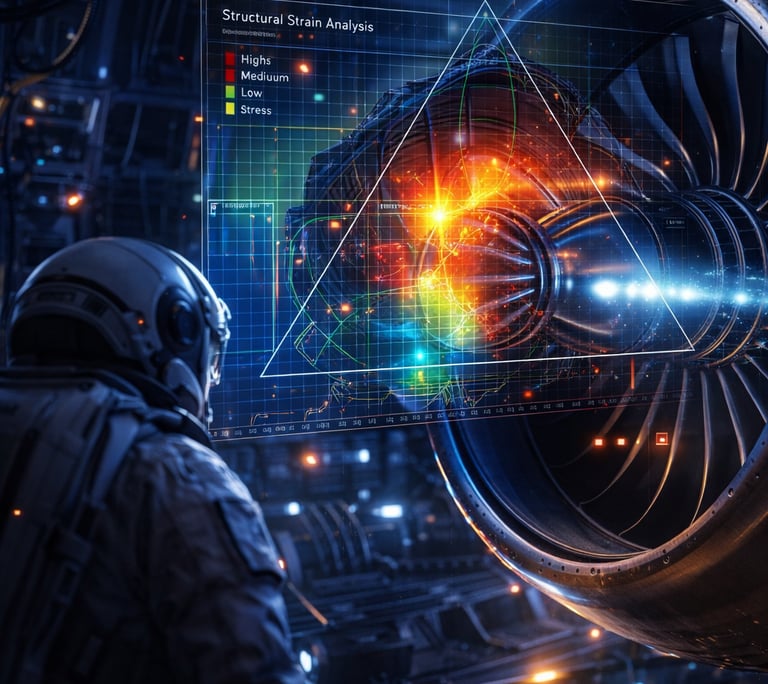
Forecast stress zones to enhance safety in aerospace design.
Aerospace
Operator-Based Simulation Across Industries
Applied operator-based modeling across industrial systems — from manufacturing to energy and infrastructure
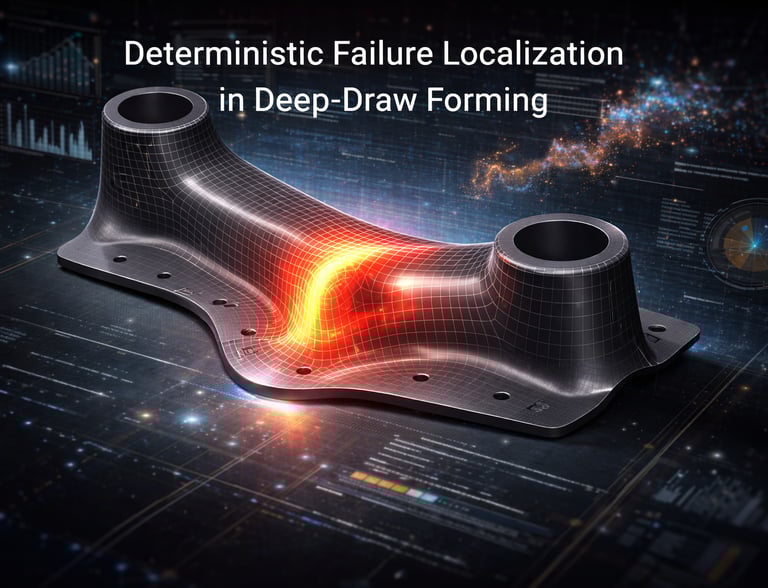
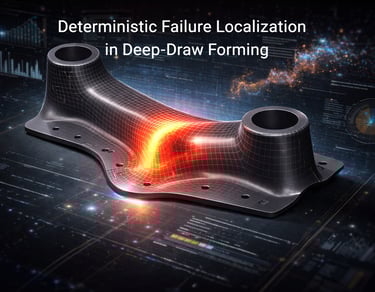


This study demonstrates that failure in deep-draw forming is not random or parameter-driven, but fundamentally governed by the geometry of the part itself. Using the NUMISHEET industrial benchmark, we applied an operator-based model that derives structure directly from geometry, rather than relying on dense mesh simulation. The result is a clear, localized prediction of the critical thinning region at the double-step geometry—matching experimental observations without iterative tuning or parameter adjustment. Traditional simulation methods distribute risk broadly across the part, often requiring multiple runs and interpretation to isolate where failure will occur. In contrast, our approach identifies a single dominant failure pathway directly from the underlying structure of the system. This shifts the problem from trial-and-error simulation toward deterministic prediction, where engineers can immediately see where material flow becomes constrained and where thinning or tearing is most likely to initiate. The implications extend beyond this single case. Many manufacturing processes—from stamped automotive components to complex structural assemblies—exhibit similar geometry-driven constraints. By resolving the operator that governs admissible motion, this method enables faster, more reliable identification of failure regions, reducing reliance on mesh refinement and opening a path toward a new class of simulation that is both computationally efficient and physically interpretable.
This study demonstrates that signal propagation in indoor wireless environments is not random or purely driven by noise, but fundamentally shaped by the geometry of the space. Using the WiFi RSSI Indoor Localization dataset, we analyzed signal strength across hundreds of spatial locations and multiple access points, revealing that weak-signal regions persist in specific, repeatable areas of the environment. Rather than relying on classical diffusion-based models, which spread signal behavior broadly and require interpretation, we applied an operator-based framework that derives structure directly from geometry. The result is a clear identification of signal pathways and dead zones, with predictions aligning closely to regions where signal propagation is consistently constrained. This approach shifts wireless analysis from probabilistic coverage maps toward deterministic, geometry-driven prediction. By resolving the underlying structure governing signal motion, engineers can directly identify where coverage fails, enabling more efficient network design, optimization, and deployment across complex indoor environments.
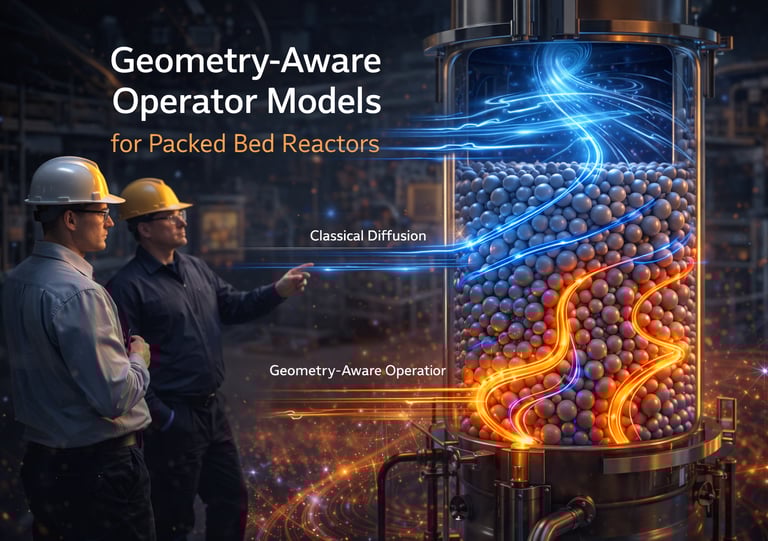
This study demonstrates that heat transport in packed bed reactors is not governed by uniform diffusion, but by the geometry of the system itself. Using controlled Weber packed-bed experiments across low-flow and high-flow regimes, we tested classical diffusion models against a geometry-aware operator framework that derives structure directly from the physical arrangement of the bed. The results show that traditional models—based on single or multi-exponential diffusion—fail to capture the true dynamics of the system. In particular, they cannot represent the plateau phase, sudden release of stored energy, or long-tailed decay observed in the experimental data. These features are not anomalies, but fundamental characteristics of transport in constrained geometries. In contrast, the operator-based model consistently captures the full structure of the system’s evolution. It reproduces both the rapid transitions and the long-term behavior without requiring empirical tuning or regime-specific adjustments. Most notably, its advantage increases significantly with flow rate, achieving a 30–40% improvement in predictive accuracy in the high-flow regime where classical assumptions break down most severely.
The Future of Simulation: From Mesh-Driven Approximation to Operator-Driven Insight
Across manufacturing, wireless systems, and packed-bed reactors, a consistent result emerges: classical mesh-driven simulation struggles where geometry governs motion. Traditional methods rely on discretizing space into millions of elements and solving diffusion-based equations that assume uniform transport. While powerful, this approach often smooths out the very structure that drives real system behavior—requiring refinement, tuning, and interpretation to recover what is fundamentally geometric.
This body of work demonstrates a different paradigm. By treating the governing operator as a function of geometry, rather than approximating it through dense meshes, simulation becomes both more deterministic and more efficient. Instead of distributing risk, heat, or signal uniformly across a domain, operator-based models identify where motion is actually constrained, where it accelerates, and where failure or inefficiency will emerge.
The implications are significant. For engineers, this means fewer simulations, faster convergence, and clearer answers—without reliance on empirical correction factors or excessive mesh refinement. For industry, it opens the door to a new class of digital twins that are not only computationally lighter, but also physically interpretable, enabling real-time insight into complex systems.
In essence, this marks a transition from simulating everything to resolving what matters. Mesh-based methods will remain valuable, but the future of simulation lies in operator-driven frameworks that capture the structure of motion directly—transforming how we design, optimize, and understand the systems that power modern technology.